Mumbai Producer Raxit Tewari Talks About His Studio Workflow With Genelec
How did your journey in music begin, and what led you to where you are today?
I started out at sixteen, writing music with a band, and that phase lasted for about a decade. After that, there was a period where I continued writing on my own, which is something I still do today under the artist name Your Chin. Alongside that, a lot of production work began to come in, so over the years it’s been a mix of band projects, solo work, and commercial production. In the last few years, it’s been a lot of commercial work and not as much solo material, and now I am trying to find a better balance between the two.
Lately, I’m really looking forward to finishing some of my tracks and releasing them and then building things around that: maybe some gigs, maybe some video content—just all those interesting, creative things that come with putting out your own material.
What kind of music and advertising work have you been doing?
Everything, really. At this point I am scoring all kinds of commercials, humorous ones, more cinematic spots, ads that need full, song-based compositions, pretty much the whole spectrum. That’s one of the fun parts of the job: every few days you’re producing something completely different. One day it might be a jazz track, the next something funky, then something super modern like hyperpop, and after that you are suddenly writing a ’90s dance song. It really goes everywhere.
How did Genelec become part of your music production journey?
It came a bit later, once I started taking production more seriously. I was earning a little more by then, so I could actually consider investing in proper monitors. I was also seeing Genelec everywhere in studios in Mumbai, they’d been around forever and had a very recognisable sound, so I was already used to hearing music through them. And, then there came a point where I realised I needed a serious set of speakers. The work had become more demanding, with fast deadlines and so I needed monitors I could trust.
I tried a lot of different options, and then I heard Genelec, The Ones, the coaxial models. That was a turning point. They weren’t just “nice-sounding” speakers, they told the truth, but in a relaxed, musical way. They didn’t feel harsh or fatiguing, yet they were incredibly revealing. I remember hearing them for the first time and suddenly being able to pick out details so clearly. As a producer, that moment is big, because once that happens, you know you can trust yourself and the speakers.
“These monitors are incredibly precise and honest. At first, that can even feel slightly disorienting, because you start hearing space between elements, between the kick and bassline, rather than everything feeling glued together. That level of separation isn’t something many monitors offer.“
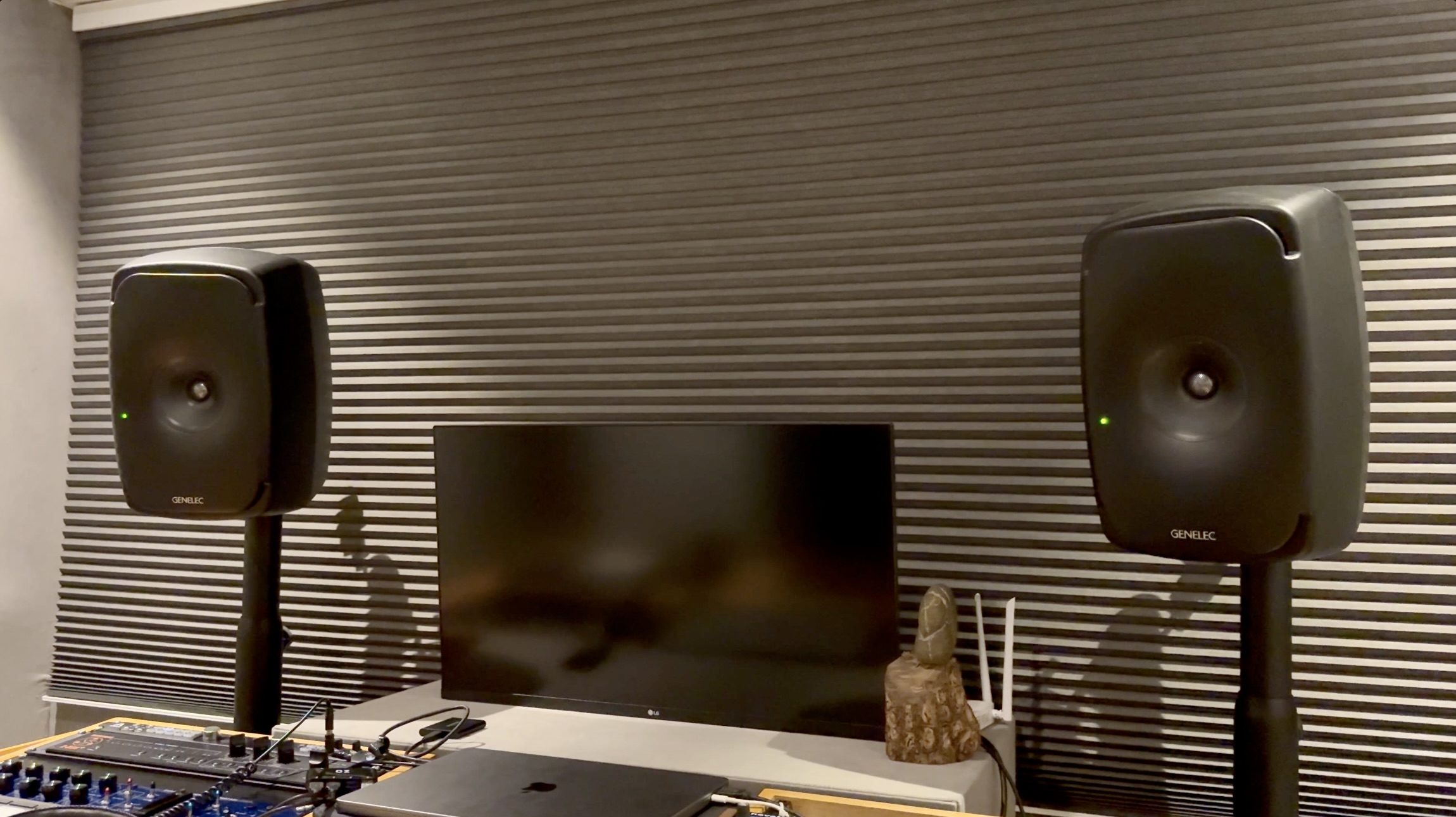
What Genelec model are you using?
I use Genelec 8351B monitors.
Why did you feel these monitors were the right fit for your studio?
In my case, it actually happened in reverse. I heard 8351B in other studios first and immediately liked how they sounded. At that point, I was moving between a lot of different studios and hearing many different monitors, and these just stood out. They aligned very closely with how I wanted to hear the sound. That’s where perspective matters. A mastering engineer, for example, might want everything as flat and neutral as possible, because their job demands that. As a musician and producer, I am looking for something slightly different. I want accuracy, but I also want inspiration.
I discussed it with my acoustician, Jayshankar, and he was completely confident they’d be a good match for the room.
These monitors are incredibly precise and honest. At first, that can even feel slightly disorienting, because you start hearing space between elements, between the kick and bassline, rather than everything feeling glued together. That level of separation isn’t something many monitors offer.
What was the inspiration behind this studio?
Very simply, it comes from spending time in well-designed listening spaces. Ever since I got into sound, and especially once I started working in cleaner, more controlled rooms where you hear the sound itself rather than the room influencing it, I knew that was the kind of environment I wanted to be in. Rooms that are truly built for listening completely change how you experience and understand sound.
As I began doing more commercial work, one of the first things I thought about was how to create that experience for myself. After a few years, it became clear that music wasn’t just a short-term thing, I knew I’d be making this for a very long time. I wanted a space where I could constantly listen, experiment, and research, and really understand how sounds interact with each other.
What were the main challenges in converting this space into a studio, and how did you address them?
I was actually quite lucky, because I had the help of a very experienced acoustician from Chennai, Jaishankar. I’d been familiar with his work for a couple of years and really liked the way his rooms sounded. What stood out to me was their sense of uniformity. You could move around the space, and the sound would not suddenly change or “shift”, which is something you often experience in less controlled rooms.
Once the studio was finished, the main challenge was simply getting used to the room, which is normal with any new space. But very quickly, things started translating well to other systems, and after that, the workflow became much faster and more confident.
How do you think Genelec have influenced your sound or music productions?
I remember that when I first started using 8351B, which I have spent the most time with, they immediately made it much easier to hear the aspects of music I actually wanted to focus on. Sound became clearer and more defined, and it was easier to understand what was really going on in a mix.
That clarity is crucial because once you start trusting your speakers, you stop second-guessing yourself. When you are working on tight deadlines, that confidence is everything. You don’t have the luxury of constantly wondering, “is this how it is going to sound everywhere?”. You need to know that the sound is nailed, that you can move to headphones, another system, or another room, and it will translate consistently.
As a producer, so much of what you do comes down to sound choice. It’s not just about having a bass line—it’s about which bass, or why a certain synth is right for the job. Why does an Oberheim sound like an Oberheim? Why does a Moog do what it does? Those distinctions live in the textures and frequencies, and being able to hear them clearly makes all the difference.
That level of clarity helps enormously when you are choosing tools or building a template for a project. When you can hear things so immediately and accurately, you make decisions faster and with more confidence. You trust your creative instincts more.
“That clarity is crucial because once you start trusting your speakers, you stop second-guessing yourself.”
And, finally, tell us about your upcoming album?
The new material will be released gradually throughout this year. In a nutshell, it leans into the electronic, indie, and alternative sounds that define this project. I have been trying to reconnect with how I used to write music a decade ago, when I was most consistent with Your Chin. The idea is to tap back into that energy while updating it to reflect who I am today.
Want to see your home studio featured in our ‘Artist Spotlight’ series?
If you’re proud of your setup, share a few photos of your space on Instagram and tag them with #GenelecIndia. We’ll be on the lookout for the most impressive and creative home rigs from across India — and your setup could be the one we feature next!
